QNR
TW EN

scroll

Go Top

Generic Drug
  • Q31

    What contents should be presented in CTD What contents should be presented in CTD Module 1.15: Status of domestic Bioavailability (BA)/ Bioequivalence (BE) Study?

    1. If the registration of generic drugs is compliance with the requirement for BA/BE study, and this study was conducted in Taiwan, the current status of the study should be reported.
    2. If the BA/BE study report has been approved, please provide the report approval letter or other certified documents.
    3. If the BA/BE study had been waived according to TFDA agreement or TFDA announcements (ex. generic drugs which are immediate-release solid oral dosages form and evaluated as drugs with low potential risk are utilized for BCS Class I-based biowaiver), applicant should clarify and provide supporting documents.
  • Q32

    CTD 3.1. Table of Contents of Module 3 is organised 5 levels of headings, if necessary, can a sixth level be extended?

    According to the suggestion of ICH M4, the Table of Contents provided under 3.1 should go down to the fifth level only (e.g. 3.2.P.2.1). Additional subsections and subheadings beyond this level (e.g. 3.2.P.2.1.1) should be used only within the dossier and not being included in the 3.1 Table of Contents. Besides, a specific Table of Contents can be created for and within a particular section that contains multiple documents within the dossier.
  • Q33

    Is a structural characterisation and/or safety data required for 3.2.S.3.2 Impurities section of ANDA submission?

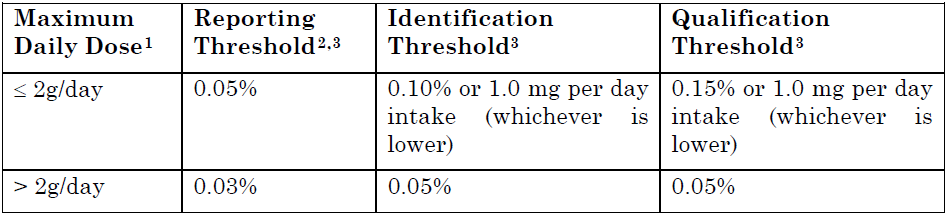
    1.The information provided by the API manufacturer can be cited to explain whether the impurity is not listed in the pharmacopoeia or whether the structural characterisation and/or safety data of the impurities is required. If yes, information on impurities should be provided. Regarding rationale for the reporting and control of impurities, see ICH Q3A: Impurities in New Drug Substances.
    2.Types of impurities, structural characterisation data and batch analysis data (including clinical, non-clinical, stability data, etc.) should be provided in 3.2.S.3.2. with explanations on whether these impurities are listed in the specifications.

  • Q34

    What information should be included in 3.2.S.4.5 Justification of Specification?

    1. If the drug substance has been listed in the pharmacopoeia, explain whether the specifications meet the requirements of the pharmacopoeia (including the monographs and the general chapters). It is recommended to use the Chinese Pharmacopoeia and the pharmacopoeia or official reference books published in the A10 countries of editions published within 5 years from the date of application.
    2. If the drug substance is not listed in the pharmacopoeia, justification should be presented for each key characteristic that can influence the performance of the drug product. 
    3. The justification for acceptance criteria of residual solvents should be presented (e.g. ICH Q3C). If residual solvents have not to be included in the drug substance specification, it should be justified (e.g. a photocopy of the CEP certificate that indicates the testing of residual solvents is not required).
    4. Reference ICH guidelines: Q3A, Q3C, and Q6A. 
  • Q35

    What information should be included in 3.2.P.2.1.1 for the small molecule chemical drug products?

    The compatibility of the drug substance with excipients listed in 3.2.P.1 should be discussed. Additionally, key physicochemical characteristics (e.g., water content, solubility, particle size distribution, polymorphic or solid state form) of the drug substance that can influence the performance of the drug product should be discussed. For combination products, the compatibility of drug substances with each other should be discussed.
  • Q36

    Where should a discussion on the ability of a functional excipient to perform through shelf-life be included?

    Discussion of the ability of functional excipients (e.g., antioxidants, penetration enhancers) to perform through shelf-life should be included in 3.2.P.2.1.2. The effectiveness of anti-microbial preservatives should be discussed in 3.2.P.2.5.
  • Q37

    Which section should the relevant information on leachables and extractables of container closure system be included in?

    The relevant information on leachables and extractables of container closure system should be included in 3.2.P.2.4. If necessary, information on leachables should also be included in 3.2.P.5.1 and 3.2.P.5.5. In addition, if leachables are confirmed through shelf-life as part of the formal stability studies, the relevant results should be presented in 3.2.P.8.3.
  • Q38

    In which section should be presented regarding to the compatibility study, for example, in use stability study of the lyophilized powder for injections with reconstitution diluents to prepare the injectable solution or the infusion solution ?

    In order to understand the compatibility of the drug product with the reconstitution diluents, relevant studies must be conducted to support the claims on the label. The data from the studies should be included in 3.2.P.2.6. If the study data is performed as part of the formal stability studies, the relevant results should be presented in 3.2.P.8.3.
  • Q39

    For 3.2.P.3.3 Description of Manufacturing Process and Process Controls, what information is required for chemical drug products?

    A flow diagram should be presented by giving the steps of the process and showing where materials enter the process. The critical steps and timings at which process controls, intermediate tests or final product controls are conducted should be identified. A narrative description of the manufacturing process, including packaging, that represents the sequence of steps undertaken and the scale of production should also be provided. Novel processes or technologies and packaging operations that directly affect product quality should be described with a greater level of detail. Equipment should, at least, be identified by type (e.g., tumble blender, in-line homogenizer) and working capacity, where relevant. Steps in the process should have the appropriate process parameters identified, such as time, temperature, or pH. Associated numeric values can be presented as an expected range. Numeric ranges for critical steps should be justified in Section 3.2.P.3.4. In certain cases, environmental conditions (e.g., low humidity for an effervescent product) should be stated. Proposals for the reprocessing of materials should be justified. Any data to support this justification should be either referenced or filed in this section (3.2.P.3.3).
  • Q40

    What information on the reference standards or materials is required for the registration of generic drugs?

    The information on the reference standards or materials recommended for the registration of generic drugs are listed as follows:
    1. The reference standards for tests should be indicated whether they are primary standard or working standard. For primary standard, the source should be specified. For working standard, the source, batch number, labelled content (or potency), testing specifications, certificate of analysis and calibration procedures should be specified. 
    2. If a compendial primary standard is used, in addition to the CoA of the primary standard, it is recommended to provide the proof of purchase, such as photographs of the primary standard indicating the lot number. 
    3. If the primary standard is provided by the manufacturer of the drug substance, the spectral analyses of the structure (e.g., IR, NMR, and MS, etc.) should be provided to support the reliability of the primary standard. If the drug substance provided by the manufacturer of the drug substance is used as a working standard, the relevant information of the primary standard that is used to qualified the working standard by the manufacturer of the drug substance should be submitted.