QNR
TW EN

scroll

Go Top

Generic Drug
  • Q11

    How should reference drugs used in the bioequivalence study be chosen?

    See the provision of Article 11 of the "Guidelines for Bioavailability and Bioequivalence Studies". The rules for the selection of the reference drugs used in the bioequivalence study are as follows:
    I. For drug products with active ingredients under surveillance (even if the pharmacovigilance period has expired), the reference drug brand product name with identification documents or the surveillance should be the first approved product in Taiwan 
    II. For drug products with active ingredients not under surveillance, the selected reference product should be confirmed with documents that identify one of the following characteristics:
    1. Brand products.
    2. An approved domestic drug product with established bioavailability.
    3. A drug product that is bioequivalent to the brand-name product or has been proved as clinically effective.
    III.In addition to the above mentioned choices, any reference products recognized by the central health competent authority can be selected.
     
  • Q12

    What kind of generic drugs do not need a bioequivalence study?

    See the provision of Article 8 of the "Guidelines for Bioavailability and Bioequivalence Studies". A bioequivalence study may be waived in any of the following conditions:
    1. Injections for intravascular administration.
    2. Oral solution with excipients that do not affect the absorption of active ingredients.
    3. Injections administrated through extravascular administrations in which the composition of a generic product, excluding for preservatives and buffers, is the same to that of corresponding brand-name products and the pH‐value of a generic product injectable solution is either the same as that of corresponding brand-name products or specified in the pharmacopoeia. 
    4. Gas or vapors for inhalation. 
    5. Generic drugs for topical use, excluding drugs absorbed through transdermal route.
    6. Ophthalmic and otic generic drugs 
    7. For a drug product in which the bioequivalence study is being replaced by the comparisons of the dissolution profile recognized by the central competent health authority, such as oral solid dosage forms with two or multiple strengths applying for registration, or post-approval change applications in which bioequivalence reports of drug products have been approved for premarketing
    8. Other cases exempted from BE studies applied for applicants and approved by the central health competent authority
  • Q13

    What are the requirements of the bioequivalence studies and clinical trials for the generic drug applications under the post-marketing surveillance period or out of the post-marketing surveillance period?

    For a generic drug application under a post-marketing surveillance period, the local clinical trial report(s) (including the bridging study report(s)) should be submitted in which the criteria of clinical trials should meet those trials carried out locally and submitted by the were not part of dossiers for original as part of NDA application. If the local clinical trial reports (including the bridging study reports) new drug application the generic drug applicant should submit one of the options [(1) BE study report(s); (2) BA study report(s) and clinical trial report(s)]. For a generic drug applications out of the surveillance period, the applicant should submit one of the options [(1) BE study report(s); (2) BA study report(s) and clinical trial report(s)].
  • Q14

    Is a bioequivalence study required for the generic drugs that active ingredient(s) are not under surveillance?

    Generic drugs, as the active ingredients one not under surveillance, can be waived for a bioequivalence study when the active substances are not in the list required for a bioequivalence study according to the announcement of the central health authority.
  • Q15

    What are the drugs with active substances that require a BE study in Taiwan?

    See the "Surveillance List of the Drugs under Surveillance"and the "Product List for BA/BE Study in Taiwan"on the website of FDA and verify whether the drug is using an ingredient under surveillance.
  • Q16

    What coverage of data is required for a stability test in the registration of generic drugs?

    Data from stability studies should be provided on at least one pilot scale batch of the drug product. The long term and accelerated testing should both cover a minimum of 6 months' duration at the time of submission. Minimum time period of 12 months' duration should be covered by long-term data at the time the approval license is granted.
  • Q17

    What is the common technical document (CTD) format?

    The International Conference on Harmonisation (ICH) developed the common technical document (CTD) format to ensure that each submission could be presented in the same format.
     
  • Q18

    What is the framework of the CTD format?

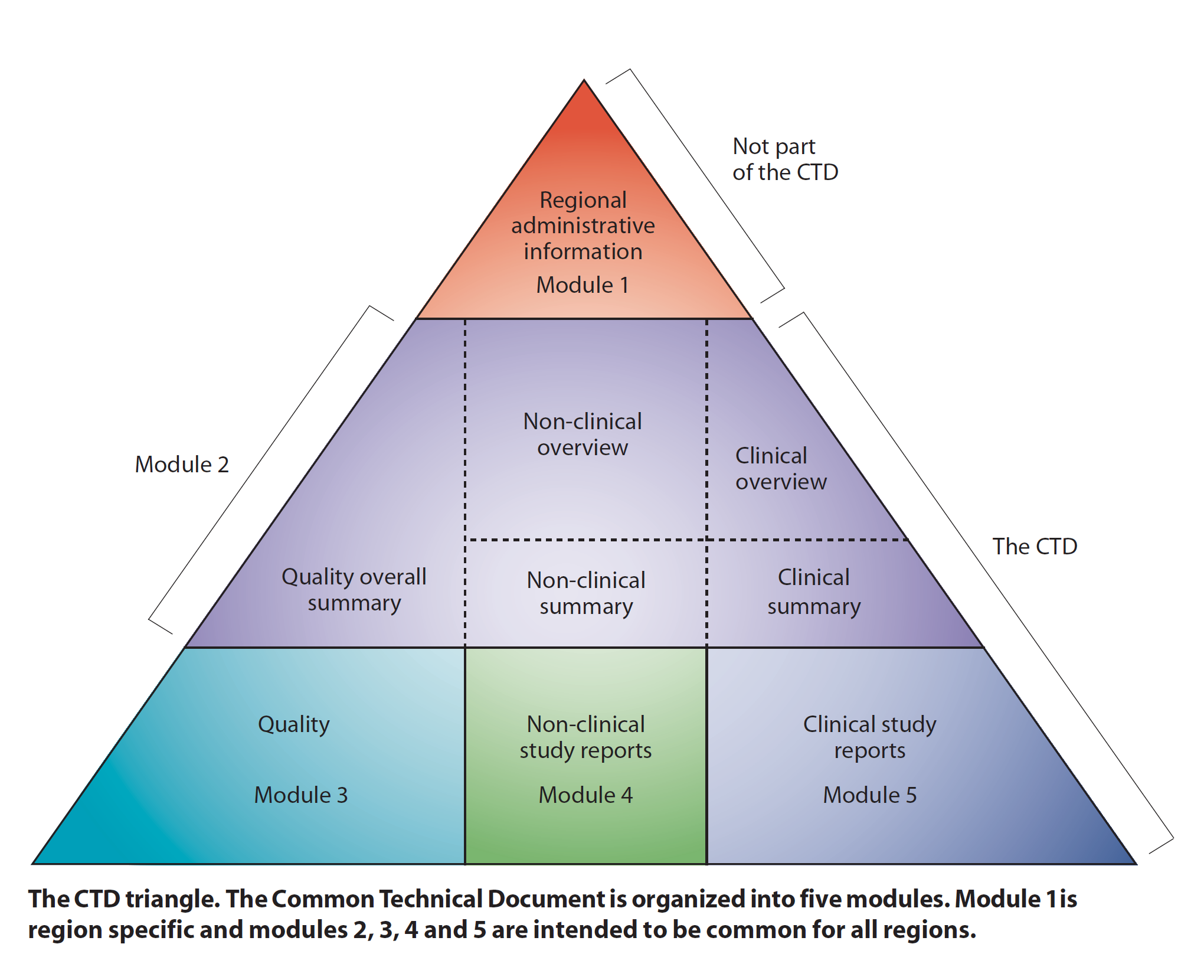
    The CTD is organised into five modules. Module 1 is region specific and Modules 2, 3, 4 and 5 are intended to be common for all regions, as shown in the following table:
    Module Content description
    Module 1 Regional Administrative Information Requirements of the regional administrative information
    Module 2 Summaries of CTD Summary of drug quality, non-clinical, and clinical data
    Module 3 Quality Chemistry, manufacturing and control (CMC) of drug substances and drug products
    Module 4 Non-Clinical Study Reports Animal pharmacology and toxicology data
    Module 5 Clinical Study Reports Clinical trials and human pharmacokinetics pharmacodynamics data
  • Q19

    When is the implementation date to submit documents for the registration of generic drugs presented in the CTD format in Taiwan?

    According to No. 1021452529 announced on October, 18, 2013 by the Ministry of Health and Welfare, the submission of generic drugs should be presented in CTD format effective on July 1, 2014.
  • Q20

    Whether the application for the registration of generic drugs could be submitted via e-CTD format?

    According to DOH No. 1011408090 dated October 15, 2012, applicants may choose one of the following methods to submit the application. Submission using the eCTD Builder announced by the TFDA is recommended. The delivery methods are described as follows:
    1. Use the eCTD Builder announced on the TFDA website to prepare the electronic files in the CTD format for the application. Specify "eCTD Builder of the TFDA is used in this application" in the documents submitted for review. 
    2. Prepare the electronic files according to the CTD Format announced by the TFDA. Files should be mainly PDF files. 
    3. Delivery of hard copies of the application.